Vector Embeddings: The Missing Layer of Understanding in AI Search
Why the future of search isn't about matching keywords — it's about mapping meaning.

Will Bradley
Founder, Precision Growth

Search has entered its post-keyword era. We're no longer optimising for strings of text — we're optimising for meaning. Vector embeddings are the engine behind this shift.

1. What Are Vector Embeddings?
A vector embedding is a numerical representation of meaning. It takes a piece of text — a sentence, a product description, a brand statement — and converts it into a list of numbers (a vector) that captures its semantic essence.
Think of it like coordinates on a map. Instead of longitude and latitude, you have hundreds or thousands of dimensions representing concepts like "financial services," "business banking," "UK market," and so on.
Example: Semantic Clustering
Consider these queries:
- "What's the best business account for SaaS companies in the UK?"
- "UK SaaS financial tools comparison"
- "Airwallex vs Wise for tech startups"
To a traditional keyword system, these are three different searches. To an embedding model, they're all asking the same thing — and they'll cluster together in vector space.

This is why AI search engines can understand paraphrases, synonyms, and intent — even when the exact words don't match. They're not looking for keyword matches. They're looking for semantic proximity.
2. Why This Matters: Retrieval → Understanding
Better Intent Matching
AI models can infer what users actually mean, not just what they literally type.
Context Awareness
Words like "bank" can mean financial institution or river bank — embeddings capture this.
Semantic Clustering
Related concepts naturally group together, enabling smarter recommendations.
(a) Traditional keyword search: If your content doesn't contain the exact phrase "business banking for startups," you won't show up — even if your product is perfect for that use case.
(b) Embedding-based search: If your content semantically aligns with the concept of "startup-friendly business accounts," you'll be surfaced — regardless of your exact wording.
(c) Why this changes everything: It shifts the game from keyword optimisation to meaning optimisation.
3. How Embeddings Work (Zero Fluff)
The 4-Step Pipeline
1
Encode Content
Your product descriptions, landing pages, and brand content are run through an embedding model (like OpenAI's text-embedding-3 or Anthropic's embedding API) and converted into vectors.
2
Encode Query
When a user asks a question, their query is also converted into a vector using the same model.
3
Compare Vectors
The system calculates the cosine similarity (or another distance metric) between the query vector and all content vectors.
4
Return Closest Matches
The most semantically similar content is retrieved and fed to the language model as context.
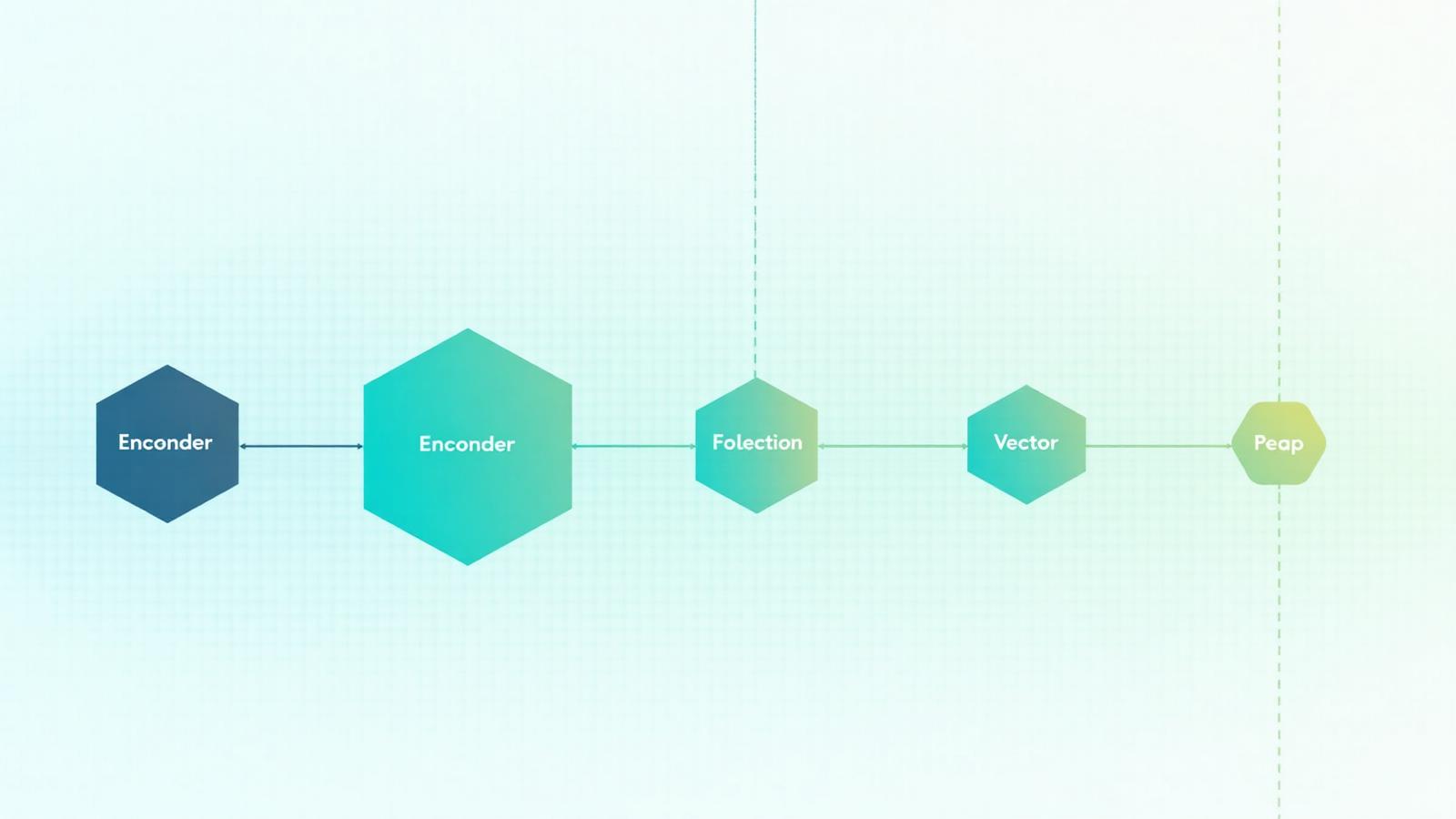
This is how systems like OpenAI's SearchGPT, Anthropic's semantic search, Pinecone, Weaviate, and every RAG (Retrieval-Augmented Generation) system works under the hood.
4. Why Embeddings Are the Foundation of AI Search
Semantic Clustering Powers Discovery
Instead of showing results based on keyword frequency, AI search engines cluster semantically similar content. If your brand sits in the "fintech for SMEs" cluster, you'll be recommended alongside other tools in that space — even if you never use those exact words.
RAG Systems Depend on It
When ChatGPT or Claude retrieves external information to answer a question, it's using embeddings to find the most relevant context. If your content isn't embedded correctly, it won't be retrieved — no matter how good your SEO is.
Better Intent Matching
Traditional search looks for exact matches. Vector search understands that "affordable business banking" and "low-cost SME accounts" mean the same thing. This means you can optimise for concepts, not just keywords.
New Ranking Layer
AI search doesn't just rank by links or engagement — it ranks by semantic relevance. The closer your embedding is to a user's query vector, the higher you rank. This is the new ranking signal.

5. What This Means for Your AI Search Roadmap
Build a Semantic Content Index
Audit your product descriptions, landing pages, and marketing content. Make sure they're semantically rich — not just keyword-stuffed. Use natural language that clearly communicates what you do and who you serve.
Map Your ICP in Semantic Space
Think about how your ideal customer would describe their problem. Then make sure your content aligns with those semantic clusters. This is the new keyword research — but instead of tracking keywords, you're tracking meaning.
Create Meaning-First Content
Write for comprehension, not just crawlers. AI models reward clarity, specificity, and semantic consistency. If your messaging is vague or generic, your embeddings will be too — and you won't rank.
Test Embedding-Powered Routing
Experiment with vector databases (Pinecone, Weaviate, Chroma) to see how well your content retrieves against real user queries. This is your new "rank tracking" — but instead of checking Google, you're checking semantic similarity scores.
Continuous Refinement
As AI search evolves, so will embedding models. Stay updated on new models (like OpenAI's latest embeddings or Anthropic's semantic APIs) and re-index your content regularly to maintain relevance.

Embeddings Are the New Ranking Factor
If you're not optimising for semantic understanding, you're not optimising for AI search.
Vector embeddings are the infrastructure layer of the new search economy. They determine how AI models understand your brand, cluster your content, and decide whether to recommend you first — or not at all.
The brands that win in AI search aren't the ones with the best backlinks. They're the ones with the clearest, most semantically aligned content in the most relevant semantic clusters.
Want help building an embedding-driven search strategy?
We help brands audit their semantic positioning, build vector-optimised content, and track their presence across AI search engines.